Water From the Land
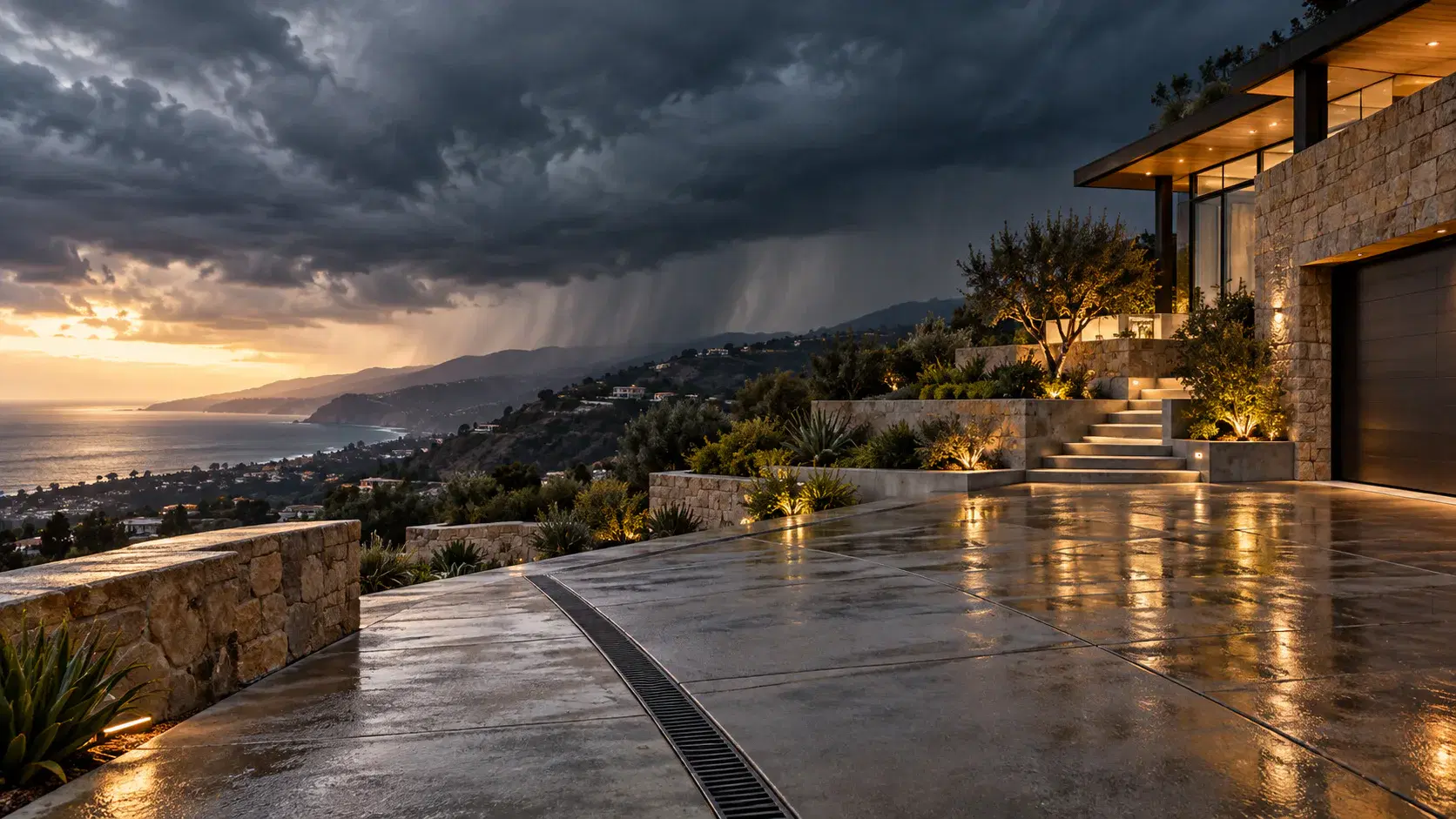
Rainfall and runoff may travel downhill from roofs, roads, hillsides, and surrounding properties.
Flood Control & Stormwater Management
Understand where water begins, how it moves through the site and which drainage, grading or erosion-control improvements can protect the whole property.
Water almost always follows the path of least resistance.
On a Southern California property, that path may lead directly toward a home, garage, foundation, retaining wall, hillside, driveway, landscape, or neighboring property.
During ordinary rainfall, a drainage problem may appear as nothing more than a puddle or a small area of erosion.
During prolonged or intense storms, that same vulnerability can become flooding, soil loss, slope damage, water intrusion, or major property damage.
Landmark Enterprise provides flood-control, drainage, erosion-control, grading, and stormwater-management solutions for residential and commercial properties throughout Los Angeles and surrounding communities.
From beachfront properties in Malibu to hillside estates and urban properties throughout Los Angeles, we help property owners understand where water is coming from, where it is going, and what can be done to manage it.
Schedule a Flood-Control Property Evaluation
Effective flood control is not simply about installing a drain.
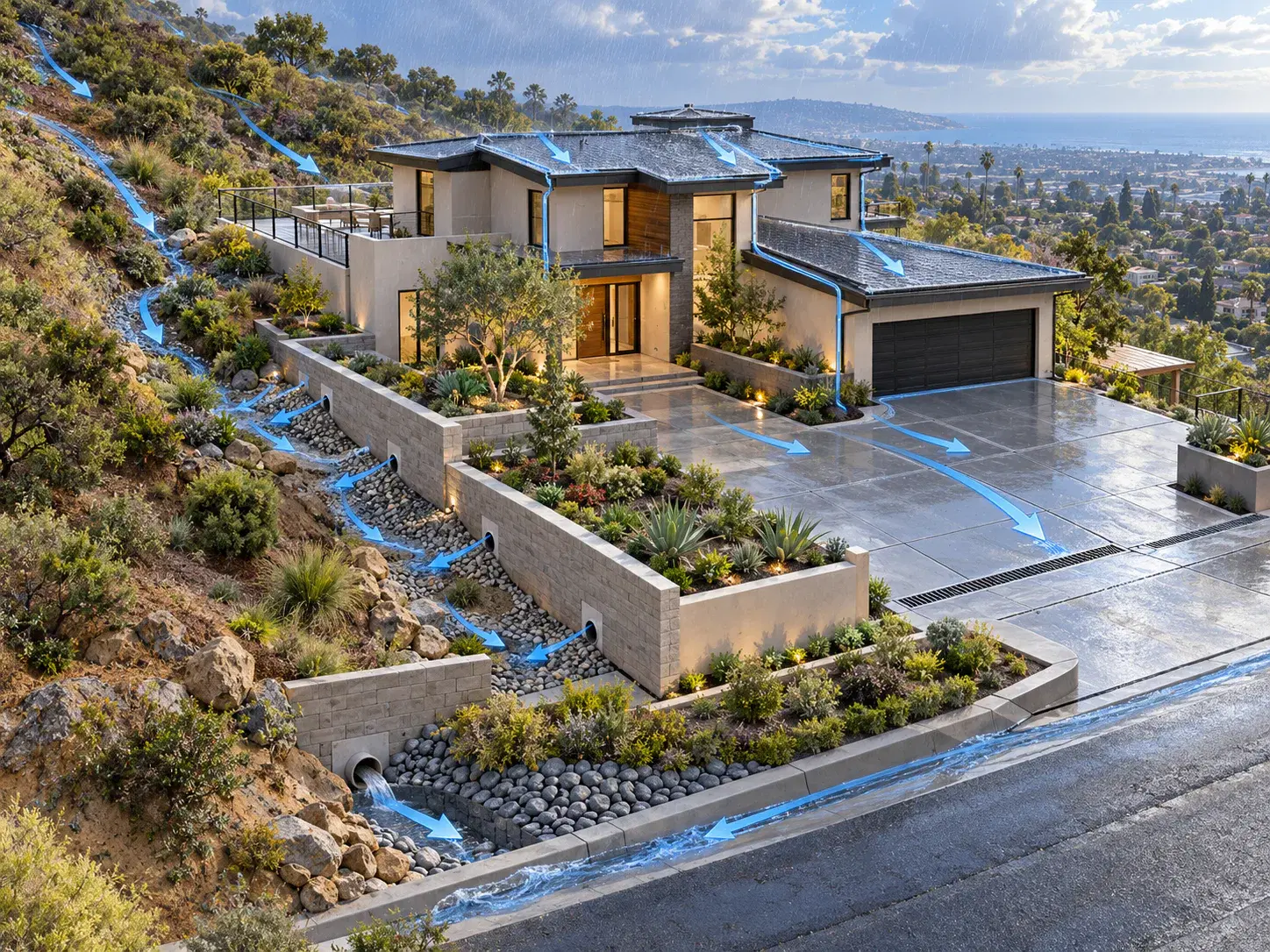
It is about understanding how water behaves across the entire site.
Rain may land on a roof, enter gutters, discharge onto hardscape, travel across landscaping, collect near a retaining wall, saturate a slope, and eventually reach the lowest portion of the property.
A problem that appears in one location may actually begin dozens or even hundreds of feet away.
That is why flood-control planning should consider:
Landmark evaluates the site as a connected system rather than treating each symptom in isolation.
Stormwater drainage systems collect and redirect water before it can accumulate in vulnerable areas.
Depending on the property, drainage improvements may include:
The appropriate system depends on the volume of water, terrain, soil, available discharge locations, and existing infrastructure.
Sometimes the most effective flood-control system is not underground.
It is the shape of the property itself.
Proper grading helps direct water away from structures and toward controlled drainage areas.
Poor grading can do the opposite.
Water may become trapped near foundations, travel across patios, enter garages, erode landscaping, or concentrate against retaining systems.
Landmark can evaluate existing grades and determine whether reshaping portions of the property may improve water movement.
The goal is simple:
Give stormwater a safe and predictable path through the property.
Water frequently collects at low points.
A properly located catch basin can intercept runoff before it reaches a vulnerable area.
Catch basins may be useful around:
Large paved surfaces can generate significant runoff.
Driveways, patios, motor courts, walkways, pool decks, and other hardscape do not absorb much rainfall.
Instead, water moves across them rapidly.
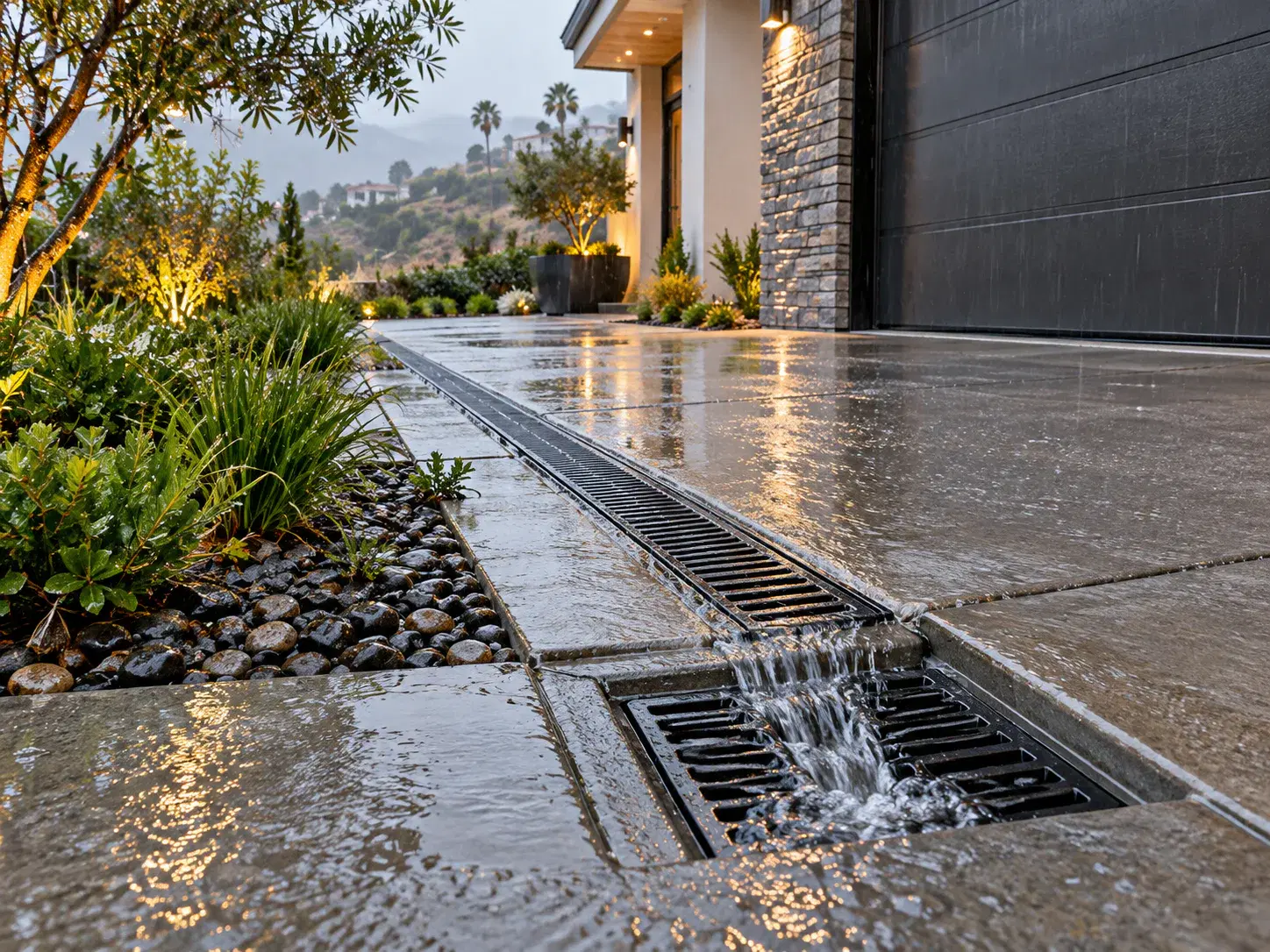
Trench and channel drains can intercept that flow before it enters a garage, building, lower yard, or other vulnerable location.
These systems can be especially useful at:
A drain that cannot accept or discharge the volume of water reaching it may simply relocate the flooding problem.
Not every water problem happens at the surface.
Water can also move through soil.
Subsurface moisture may collect behind retaining walls, saturate landscape areas, migrate toward foundations, or contribute to unstable soil conditions.
French drains and other subsurface drainage systems may help collect and redirect groundwater or water moving through saturated soil.
A typical system may incorporate:
Installing a French drain simply because an area is wet is not always the correct solution.
The source of the moisture needs to be understood first.
Gravity accelerates runoff.
Water moving down steep terrain can quickly concentrate into channels, remove soil, damage landscaping, overwhelm drains, or saturate vulnerable areas.
Hillside properties may require a combination of:
Because hillside drainage and erosion are closely connected, treating one without considering the other may leave the underlying problem unresolved.
Retaining walls do more than hold soil.
They also have to manage water.
Water collecting behind a retaining wall can increase pressure against the structure.
Warning signs may include:
Drainage improvements may involve clearing existing systems, improving surface drainage, installing or repairing subsurface drainage, or incorporating drainage work into a larger retaining-wall repair.
Structural movement should be evaluated by the appropriate professional.
Driveways often become unintentional drainage channels.
A sloped driveway can direct substantial volumes of water toward a garage or lower portion of a property.
Common solutions may involve:
For properties with long hillside driveways or large motor courts, several strategies may need to work together.
A flooded yard is sometimes dismissed as a landscaping problem.
It may actually reveal a much larger drainage issue.
Standing water can indicate:
Before installing additional drains, Landmark looks at why the water is accumulating in the first place.
A roof collects an enormous amount of water during a storm.
That water needs somewhere to go.
When downspouts discharge directly beside a structure, onto a hillside, or into an undersized drainage system, roof runoff can contribute to:
Connecting roof drainage into an appropriately designed site system can significantly improve stormwater management.
Los Angeles hillside properties can have some of the most complex drainage conditions in Southern California.
Water may move from one elevation to another through:
During heavy storms, runoff that appears manageable near the top of a property can accelerate dramatically before reaching the bottom.
Flood-control planning for hillside homes may therefore require multiple drainage systems operating together.
Landmark can help property owners evaluate the complete path of water through the site.
Waterfront properties face two very different sources of water.
Rainfall and runoff may travel downhill from roofs, roads, hillsides, and surrounding properties.
High surf, wave run-up, elevated tides, coastal flooding, and erosion may affect the opposite side of the property.
During severe coastal storms, both forces can occur at the same time.
That means beachfront flood-control planning may require consideration of:
Explore El Niño Storm Preparation
Flooding and erosion should rarely be considered separately.
Moving water carries soil.
Once erosion creates a low point or channel, future water naturally follows it.
That concentrates runoff even further.
Over time, the cycle can become progressively worse:
Runoff → erosion → deeper channel → more concentrated runoff → more erosion
Breaking that cycle may require both drainage and soil protection.
Landmark can integrate flood-control work with erosion-control solutions when necessary.
You do not need to wait until water enters the building.
Earlier warning signs often appear first.
Look for:
Runoff across a hillside may create a channel that becomes larger during every storm.
Correcting drainage early can often prevent far more complicated repairs later.
A property may already have drainage infrastructure but still experience flooding.
That does not necessarily mean the entire system needs to be replaced.
Existing systems may fail because of:
Landmark can investigate the system and determine whether repair, modification, expansion, or replacement makes the most sense.
Moving water still needs somewhere to go.
A drainage system that simply concentrates water at an unprotected outlet can create another problem.
High-volume discharge can erode soil rapidly.
Outlet areas may require:
For seasonal prevention and post-storm steps, read the 2026–27 El Niño article.
Flood-control work becomes particularly important when Southern California enters periods where repeated storms are possible.
The greatest problems often do not occur during the first rainfall.
They develop after the soil has already become saturated and drainage systems have been carrying water repeatedly.
That can increase:
Preparing before the storm season allows drainage systems to be evaluated and improvements to be made while the property is still accessible.
Explore El Niño Storm Preparation
Permanent improvements are preferred whenever practical, but some properties require short-term protection while permanent work is being designed, permitted, or constructed.
Temporary measures may include:
Temporary protection should not be considered a substitute for solving a known long-term drainage problem.
Sometimes the water has already won the first round.
After flooding, Landmark can help property owners move from cleanup toward repair and prevention.
Flood-related work may include:
The goal should not simply be to restore the property to the condition it was in before the storm.
If the previous condition allowed the damage to occur, the recovery process is also an opportunity to correct the underlying vulnerability.
When emergency construction response is appropriate, Landmark can help property owners identify immediate priorities and develop a plan for stabilization and recovery.
Safety always comes first.
Floodwater, unstable slopes, active debris flows, electrical hazards, and moving water should never be entered simply to protect property.
One of the advantages of working with a full-service contractor is the ability to look beyond the immediate drainage problem.
Stormwater can affect:
When damage extends beyond the drainage system itself, Landmark can help coordinate the larger construction response.
Landmark works with homeowners throughout Los Angeles to protect residential properties from stormwater and runoff.
Residential projects may include:
Stormwater problems are not limited to homes.
Commercial and multifamily properties may experience:
Drainage planning can be incorporated into repair, renovation, site-improvement, and property-maintenance projects.
Some properties simply require more planning.
Luxury and hillside properties may include:
Landmark approaches these sites with the understanding that the drainage solution has to work with the entire property.
A drain is only useful if water actually reaches it and the system has somewhere appropriate to send that water.
Our approach considers the complete site.
If drainage work reveals damaged grading, hardscape, retaining systems, slopes, or other construction needs, Landmark can help address the larger project.
Los Angeles properties often involve terrain and site conditions that require more than a basic landscape-drainage solution.
We help property owners both prepare for storms and recover when damage has already occurred.
Every site is different.
The solution should reflect the property rather than forcing the property to fit a predetermined drainage product.
Landmark Enterprise provides flood-control and stormwater-management services throughout Los Angeles and surrounding communities, including:
If every storm requires pumps, sandbags, towels, cleanup, or emergency calls, the property is telling you something.
There may be a better way to manage the water.
Landmark Enterprise can evaluate the site, identify drainage and runoff concerns, and develop a construction strategy designed around the property.
Flood Control \| Stormwater Drainage \| Grading \| Erosion Control \| Storm Damage Repair
Call Landmark Enterprise: (661) 674-7852
Property Evaluation
Tell us where water is collecting, how it moves through the property and what damage or warning signs you have observed.
Your information is kept private and confidential.