
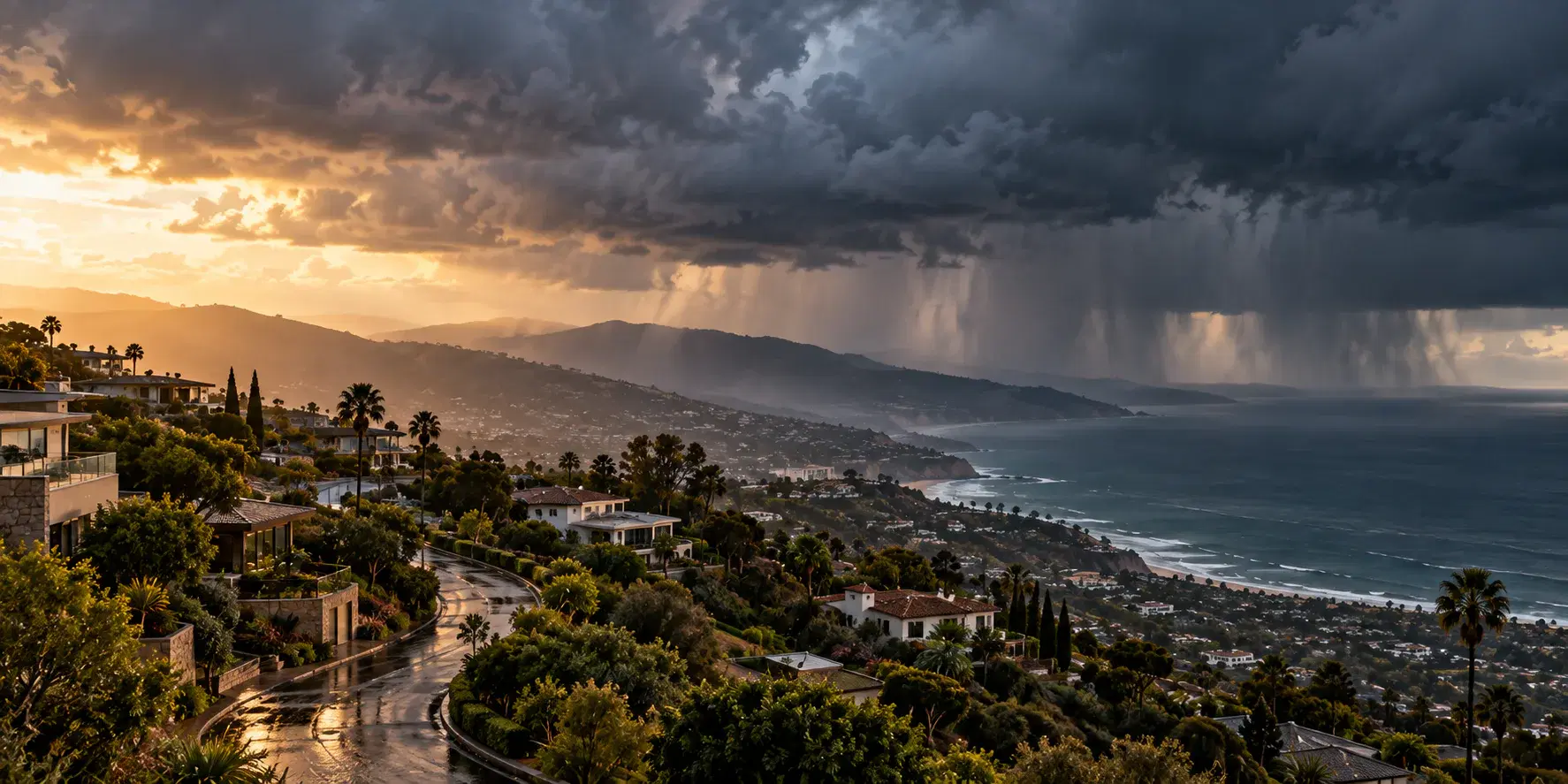
Southern California property owners have good reason to pay attention to this winter.
As of September 2026, NOAA has issued an El Niño Advisory and reports that El Niño is strengthening, with a greater than 90% chance of becoming a very strong event during fall and winter 2026-27. NOAA also reports a 75% chance that the October through December period reaches a level that would exceed previous El Niño events in its historical record dating to 1950.
That does not mean Los Angeles is guaranteed to experience catastrophic rainfall.
It does mean this is a storm season worth preparing for.
For homeowners in Malibu, Pacific Palisades, the Santa Monica Mountains, Los Angeles hillside communities, and other areas where homes interact with steep terrain, drainage systems, burn scars, bluffs, or the coastline, heavy weather can expose vulnerabilities that remain almost invisible during dry Southern California months.
The time to find those vulnerabilities is before the first major storm arrives.
What Does El Niño Actually Mean for Los Angeles?
El Niño is part of a naturally occurring climate pattern involving warmer-than-normal ocean temperatures in portions of the tropical Pacific and corresponding changes in atmospheric circulation.
Those changes can affect weather patterns across the globe.
In Southern California, strong El Niño events can increase the possibility of conditions associated with significant winter storms. However, NOAA cautions that even a very strong El Niño does not guarantee a particular local weather outcome.
That distinction matters.
Preparing for El Niño should not mean assuming that every home in Los Angeles is about to flood.
It means recognizing that the potential consequences of a major storm are heavily influenced by the condition of the property before that storm begins.
A well-functioning drainage system, stable slope, protected soil, clear runoff path, and properly maintained coastal property may respond very differently from a property where small problems have been developing unnoticed for years.
For Property Owners, the Real Question Is: Where Will the Water Go?
Southern California spends much of the year dry.
That makes it remarkably easy to forget how much water can move through a property during sustained rainfall.
Think about everything that collects rain:
- Roofs
- Driveways
- Patios
- Walkways
- Pool decks
- Hillsides
- Retaining walls
- Landscaped terraces
- Private roads
- Neighboring slopes
- Large areas of hardscape
All of that water begins moving downhill.
If it has a safe path, the property may handle it without incident.
If it does not, runoff can begin collecting against structures, crossing driveways, saturating soil, overwhelming drains, eroding slopes, or moving toward the lowest part of the property.
That is why effective flood control and stormwater management begins with understanding the whole site, not simply installing another drain where water happened to puddle last winter.
Explore Flood Control & Stormwater Management
1. Drainage Problems Can Become Flood Problems Quickly
One of the first places to look before storm season is the property's existing drainage.
A drain that appears functional during light rain may not perform the same way during a sustained storm.
Leaves, roots, sediment, broken pipes, poor grading, undersized infrastructure, or badly positioned collection points can all reduce the effectiveness of a drainage system.
Watch for warning signs such as:
- Standing water after rain
- Water moving toward the house
- Overflowing catch basins
- Sediment collecting inside drains
- Water entering a garage
- Drain outlets eroding surrounding soil
- Constantly wet landscape areas
- Downspouts discharging beside foundations
- Recurring puddles in the same locations
- Water emerging unexpectedly through retaining walls
Los Angeles County recommends clearing debris and overgrowth from gutters and storm drains before heavy rain begins. The County also advises residents to pay particular attention to flood hazards in low-lying areas, near waterways, and below recently burned hillsides.
Sometimes cleaning and maintenance solve the immediate issue.
Other times, these symptoms point to a larger problem with the way water is being collected, directed, or discharged.
2. Erosion Often Starts Small
Flooding is dramatic.
Erosion often is not.
At least, not at first.
Water may begin cutting a shallow path through landscaping. A drainage outlet may slowly wash away surrounding soil. A bare slope may lose a little material each time it rains.
Over multiple storms, however, those changes can become increasingly significant.
Water naturally begins following the channels previous storms created.
That means erosion can become self-reinforcing:
Water concentrates in one area → soil washes away → the channel gets deeper → more water follows the same path → erosion accelerates.
Eventually, erosion can affect landscaping, slopes, driveways, retaining systems, drainage infrastructure, foundations, or access around the property.
If you can already see exposed soil, washout, new channels, or sediment accumulating downstream, the property is giving you useful information before the major storms arrive.
3. Hillside Homes Face a Different Kind of Storm Risk
Los Angeles is full of homes built into terrain that would make construction challenging almost anywhere else.
Those hillside and canyon settings are also places where stormwater deserves particular attention.
As rain falls on a slope, several things can happen at once:
Surface runoff accelerates downhill.
Water enters the soil.
Drainage systems begin carrying greater volumes.
Retaining systems encounter additional moisture.
Existing erosion may worsen.
Soil that was dry for months begins becoming saturated.
None of those conditions automatically means a hillside is unstable. But visible changes around a slope should not be ignored.
Signs worth investigating include:
- New cracks in soil
- Small areas of slumping
- New erosion channels
- Mud collecting below a slope
- Water unexpectedly emerging from the hillside
- Tilting fences
- Retaining-wall movement
- Significant sediment in drainage systems
- Previously dry areas remaining saturated
- Changes following a recent storm
Los Angeles County specifically identifies steep hillsides and canyons as areas where residents should be aware of debris and mudflow hazards.
4. Burn Areas Deserve Extra Attention
Fire and flood risk are closely connected in Southern California.
Vegetation normally helps intercept rainfall, hold soil together, and slow runoff. After a wildfire, those protective conditions may be significantly reduced.
When intense rain reaches a recently burned watershed, runoff can carry mud, soil, rocks, branches, and other debris downhill.
Los Angeles County warns that areas stripped of vegetation by fire are particularly vulnerable to debris and mudflows and that the severity of those flows depends in part on rainfall intensity, storm duration, and vegetation recovery.
For properties below or near fire-affected slopes, preparation should include looking beyond the house itself.
Consider:
- Drainage paths above the property
- Culverts
- Channels
- Hillsides
- Debris collection areas
- Low points
- Access roads
- Driveways
- Previous erosion
- Places where runoff could become concentrated
If your property has already been affected by wildfire, storm preparation should be part of the overall recovery conversation.
5. Malibu and Beachfront Properties Face Water From Two Directions
Coastal homes can experience an entirely different combination of conditions.
Rainwater moves downhill from the land.
At the same time, large waves, high tides, elevated ocean levels, wave run-up, and coastal erosion may be acting from the opposite direction.
The California Coastal Commission has specifically advised coastal property owners to prepare for the 2026-27 El Niño, noting the potential for heavy rainfall, stronger storms, large waves, flooding, and erosion.
For beachfront and bluff properties, owners should inspect areas such as:
- Seawalls
- Revetments
- Bluff edges
- Shore-facing slopes
- Drainage outlets
- Retaining systems
- Areas showing previous erosion
- Exposed foundations or footings
- Locations where beach material has been lost
- Areas where runoff crosses toward the ocean
The Coastal Commission also recommends inspecting existing shoreline-protection structures for distress, missing material, and drainage problems before major storms occur.
There is another reason to start early: coastal construction can involve additional permitting requirements.
Grading, bluff alteration, shoreline protection work, and certain activities involving mechanized equipment near beaches or coastal floodplains may require approval. Emergency work can also have different requirements than permanent repairs.
Waiting until waves or erosion are actively threatening the property can dramatically reduce the amount of time available to plan.
What Should Los Angeles Homeowners Do Before the Rain Arrives?
You do not need to turn your property into a fortress because an El Niño advisory exists.
You should use the warning as an opportunity to inspect the things that matter.
Walk the Property From High Point to Low Point
Instead of looking only around the house, start uphill.
Imagine rain falling across the entire site.
Where will it travel?
Look at roofs, gutters, landscaping, slopes, patios, driveways, retaining walls, drains, and discharge points.
Then follow the likely path downhill.
This exercise frequently reveals issues that are easy to miss when evaluating individual drains in isolation.
Clear Gutters, Drains and Drainage Paths
Remove leaves, sediment, vegetation, and debris that could restrict water flow.
Check catch basins and visible drainage outlets.
Los Angeles County Public Works recommends beginning storm-season preparation before the October through April rainy season because flooding and debris flows can make emergency work substantially more difficult once storms are already occurring.
Look for Evidence From Previous Storms
Old storm damage is often a map showing where future problems could occur.
Look for:
- Soil that has washed away
- Sediment deposits
- Water staining
- Mud lines
- Damaged landscaping
- Cracked hardscape
- Previous sandbag locations
- Exposed pipes
- Scouring around drain outlets
- Areas that repeatedly collect water
If the same area requires attention after every major storm, there may be an underlying drainage or grading problem worth solving permanently.
Inspect Slopes and Retaining Areas
Look for visible changes rather than trying to diagnose the engineering yourself.
Cracks, erosion, unusual moisture, wall movement, or new soil displacement are reasons to bring in the appropriate professionals.
Check How Roof Water Leaves the Property
Roof runoff represents a significant amount of water concentrated into gutters and downspouts.
Make sure that water is not simply being deposited beside foundations, onto vulnerable slopes, or into landscape areas with nowhere to drain.
Address Bare and Eroding Soil
Exposed soil is far more vulnerable to runoff.
Depending on the property and conditions, erosion-control measures may involve vegetation, mulch, erosion-control materials, rock protection, grading, improved drainage, or more substantial stabilization.
Do Not Forget the Drainage Outlet
Getting water into a pipe is only half the job.
Where does that pipe end?
A system that collects water successfully but releases a concentrated stream onto unprotected soil can create erosion farther downstream.
The entire drainage path matters.
What Can Be Improved Before a Major Storm?
Once the source and path of the water are understood, property improvements can be tailored to the site.
Depending on the conditions, that might involve:
Catch Basins
Catch basins can collect surface runoff at low points before water reaches structures or vulnerable areas.
Trench and Channel Drains
These are particularly useful for intercepting water crossing driveways, garage entrances, courtyards, patios, and other hardscape.
French Drains and Subsurface Drainage
When the issue involves water moving through saturated soil rather than across the surface, subsurface drainage may be appropriate.
Grading
Sometimes water is going exactly where the property tells it to go.
Changing the grade can help establish positive drainage away from structures and toward appropriate collection or discharge areas.
Hillside Drainage
Slope drains, swales, catch basins, retaining-wall drainage, subsurface systems, and erosion protection may need to work together on hillside properties.
Erosion Control
Managing the water and protecting the soil are often two parts of the same solution.
Temporary Storm Protection
When permanent work cannot be completed before a storm, temporary protection may be appropriate depending on the site.
The important thing is not choosing a product first.
It is identifying the actual problem first.
Explore Flood Control & Stormwater Management
What Happens If the Storm Gets There First?
Preparation is ideal.
Reality does not always cooperate.
If a property is damaged by flooding, erosion, mud, debris, waves, or runoff, the immediate priority is safety.
Do not enter moving floodwater, unstable slopes, active debris-flow areas, or dangerous coastal conditions to protect property.
Los Angeles County warns that as little as six inches of moving water can knock a person off their feet and advises residents to stay away from streams, flood-control channels, and other areas subject to sudden flooding.
Once conditions are safe, recovery generally involves two different questions.
What Needs to Be Stabilized Right Now?
That might mean:
- Removing mud or debris
- Restoring access
- Clearing drainage
- Protecting an exposed area
- Controlling additional runoff
- Temporarily stabilizing damaged soil
- Preventing additional water from reaching a vulnerable area
Why Did the Damage Happen?
This is the question that matters long term.
Cleaning mud from a driveway solves today's problem.
It does not explain why the mud reached the driveway.
Replacing washed-out landscaping restores appearance.
It does not prevent the next storm from washing it out again.
Repairing water damage inside a structure does not necessarily address the drainage condition outside that allowed the water to reach it.
Good storm recovery should move beyond cleanup and ask how the property can perform better during the next event.
Prevention and Remediation Should Be Part of the Same Plan
At Landmark Enterprise, we approach storm-related work from a construction perspective.
Water problems rarely respect trade boundaries.
Drainage can affect landscaping.
Landscaping can affect erosion.
Erosion can affect slopes.
Slope conditions can affect retaining systems.
Flooding can damage hardscape, foundations, garages, access roads, and structures.
Coastal erosion can involve grading, structural work, shoreline protection, engineering, permitting, and reconstruction.
That is why Landmark can help property owners think beyond a single drain or temporary patch.
Depending on the project, our work can include:
- Flood-control improvements
- Stormwater drainage
- Catch basins and trench drains
- Grading and runoff management
- Erosion control
- Hillside drainage
- Site stabilization
- Mud and debris removal
- Storm-damage repair
- Hardscape restoration
- Coastal property work
- Construction and reconstruction
- Coordination with engineers and other project professionals
For properties with known storm vulnerabilities, the objective is prevention.
For properties that have already been damaged, the objective is recovery without simply recreating the same vulnerability.
Why Preparing Early Matters
There is a practical advantage to evaluating a property before a storm.
The ground is accessible.
Drains can be inspected.
Excavation is easier.
Contractors can safely reach the work area.
Materials can be staged.
Problems can be investigated methodically instead of during an emergency.
Permitting questions can be addressed.
Permanent improvements may still be possible.
Once a major storm begins, options can narrow quickly.
Los Angeles County's own homeowner guidance recommends preparing before the rainy season specifically because flood and debris-flow conditions make emergency work more difficult once storms arrive.
The California Coastal Commission is making a similar recommendation for the 2026-27 El Niño, encouraging coastal property owners to inspect and address vulnerabilities before severe weather reaches the coast.
Don't Panic About El Niño. Prepare for It.
A strong El Niño forecast makes a good headline.
For a homeowner, the more useful question is much simpler:
Is my property ready for a significant storm?
You cannot control how much rain falls.
You cannot control the waves.
You cannot control when the next storm arrives.
But you can identify drainage problems, existing erosion, vulnerable slopes, coastal exposure, and previous damage while there is still time to do something about them.
That is where preparation becomes valuable.
If you are concerned about how your property may perform during the 2026-27 storm season, Landmark Enterprise can help evaluate the site and determine what steps make sense before problems become emergencies.
Explore El Niño Storm Preparation in Los Angeles
Explore Flood Control & Stormwater Management
Plan Before the Storm
Concerned About Flooding, Drainage, Erosion or Storm Damage?
Landmark Enterprise works with homeowners throughout Malibu, Pacific Palisades, Santa Monica, Beverly Hills, Bel Air, Brentwood, Calabasas, and the greater Los Angeles area to address complex coastal, hillside, drainage, and property-construction needs.
We can help you evaluate existing vulnerabilities, determine the appropriate next steps, and move from storm preparation to permanent construction solutions when needed.